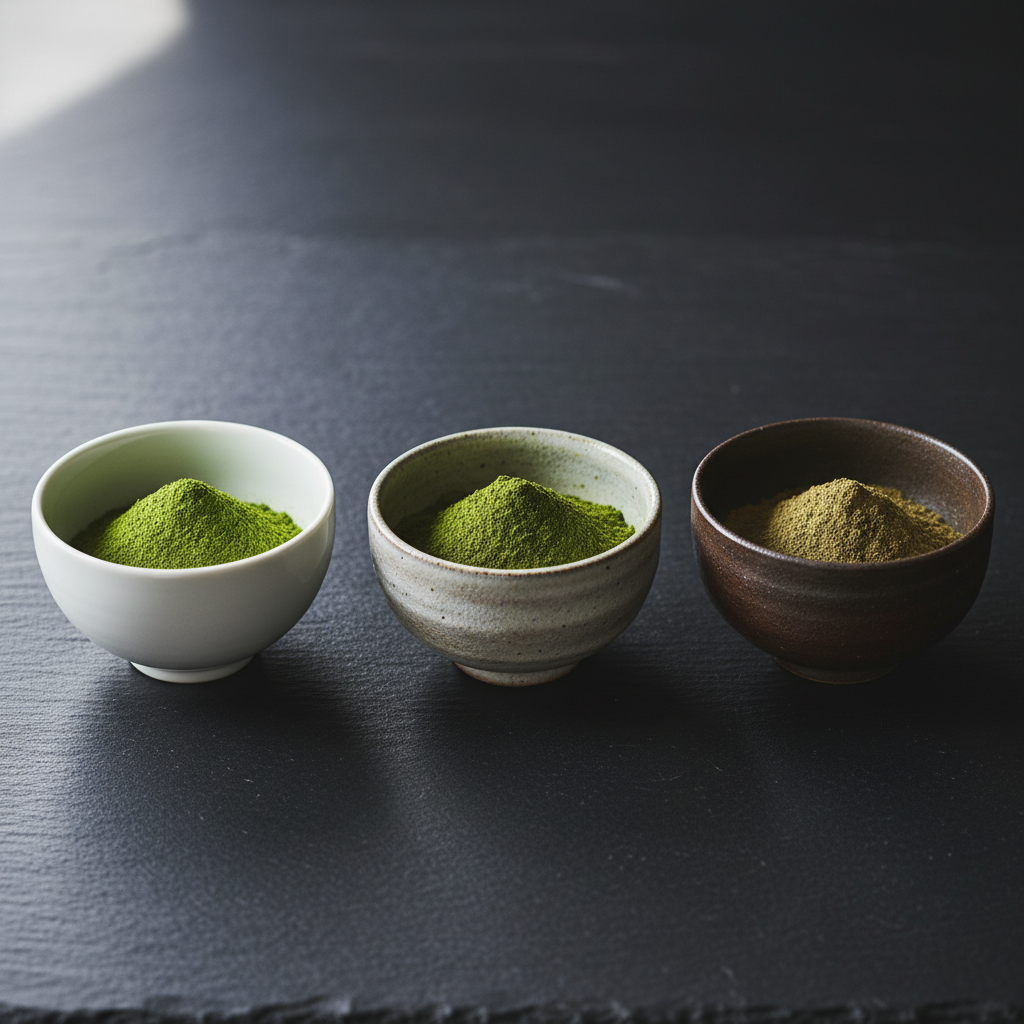
When people talk about "matcha," most think of a single beverage. However, in Japan, matcha is prepared in two radically different ways: koicha and usucha. Here's everything you need to know to choose the right preparation.
Two Preparations, Two Worlds
Usucha (薄茶, literally "thin tea") and koicha (濃茶, "thick tea") are the two codified matcha preparations in the Japanese tea ceremony. They use the same matcha powder, but in proportions and with techniques that have nothing in common.
Choosing between the two is not a matter of personal preference; it's a matter of context, grade, and occasion. A koicha drunk like an usucha would be undrinkable, and vice versa.
Usucha: Everyday Matcha
Recipe
- 2 g of matcha (about 1 rounded chashaku spoon)
- 70 ml of water at 80 °C
- Whisk with a chasen (bamboo whisk) in a rapid "M" or "W" motion for 15-20 seconds
- Expected result: a fine, uniform foam that covers the surface
Texture and Taste
Usucha is light, airy, and frothy. It's drunk in one go or in two sips. The taste is clear, vegetal, with a moderate bitterness softened by the foam.
When to Drink It
For breakfast, mid-morning, before intellectual effort. It's the default preparation at home and in tea rooms. Usucha is also served at the beginning of a formal tea ceremony.
Which Matchas to Use
All usucha grades: at Marukyu-Koyamaen, Isuzu, Wako, Yugen. You can also use a koicha as an usucha (it would just be a financial waste), but the reverse is very risky.
Koicha: Matcha for Special Moments
Recipe
- 4 g of matcha (double an usucha)
- 30 ml of water at 80 °C (less than half)
- Knead slowly with a chasen in circles, without whisking — the motion is more like mixing a paste than whisking
- Expected result: a fluid, glossy, uniform paste, without foam
Texture and Taste
Koicha is thick, syrupy, almost creamy. Its texture is reminiscent of warm melted chocolate. The taste is intense, umami, with a slight natural sweetness and a long finish. A good koicha is never bitter — that's precisely the test of its grade.
When to Drink It
During formal tea ceremonies (chaji), to mark an important moment, or simply on the weekend when you want to take your time to savor it. A koicha is drunk slowly, in three sips, becoming aware of each nuance.
Which Matchas to Use
Only matchas classified as koicha by the producer. At Marukyu-Koyamaen: Kinrin, Unkaku, Tenju. An entry-level usucha prepared as a koicha will be unbearably bitter and astringent.
Comparative Table
| Criterion | Usucha | Koicha |
|---|---|---|
| Matcha | 2 g | 4 g |
| Water | 70 ml | 30 ml |
| Technique | Whisk (rapid M/W) | Knead (slow circles) |
| Result | Frothy | Syrupy, no foam |
| Taste | Fresh, vegetal | Intense, umami, long |
| Required Grade | Any usucha | Koicha only |
| Occasion | Daily | Special moment |
Recommended Progression
If you're new to matcha, start by mastering usucha with an accessible grade like Marukyu-Koyamaen's Isuzu. It often takes 4 to 5 attempts to get a beautiful stable foam with the chasen — that's normal, the technique requires practice.
Once you've mastered usucha, move up in grade (Wako, then Yugen) to understand the nuances between grades. Only then is it worthwhile to invest in a koicha: your palate will have the benchmarks to appreciate its depth.
Our Japanity Selection
Our Marukyu-Koyamaen collection offers both worlds: three usucha (Isuzu, Wako, Yugen) for your daily progression, and two koicha (Kinrin, Unkaku) for your exceptional moments. Each product page indicates the recommended preparation.
Want to taste the difference between an usucha and a koicha? Explore the Marukyu-Koyamaen collection and make your choice by use.