Japanese snack boxes are a huge hit online. Instead of subscribing, why not create your own custom box, for yourself or as a gift? Here's how.
Why make your own box?
Classic subscription boxes are convenient, but have several limitations:
- You receive what they choose.
- Many duplicates from one month to the next.
- Often more expensive than a direct selection.
Creating your own homemade box allows you to choose exactly what you like, balance sweet/savory, and customize it for a gift.
The 5 pillars of a good box
1. A discovery classic
Always include an iconic product that everyone recognizes: chocolate Pocky, matcha KitKat, Ramune. Creates an immediate connection.
2. A seasonal surprise
A limited edition of the moment: sakura Pocky in spring, Mont Blanc Pocky in autumn. Rarity creates magic.
3. A savory snack
To balance: Pretz, Cheeza, Kaki no tane (peanuts and soy crackers).
4. A drink
Ramune, Itoen Oi Ocha, Calpis. A drink makes the box visually "complete."
5. A curiosity
To spice things up: assorted Umaibos, sake KitKat, yuzu candy, wasabi Pocky. This is what gets people talking.
Compositions by profile
"Beginner" Box (€15-20)
- 1 chocolate Pocky
- 1 matcha KitKat
- 1 Salad Pretz
- 2 Hi-Chew (strawberry and grape)
- 1 Ramune
- 3 assorted Umaibos
"Sweet Lover" Box (€20-25)
- 1 strawberry Pocky
- 1 almond crush Pocky
- 1 wasanbon strawberry KitKat
- 1 strawberry Bisco
- 1 konpeito bag
- 3 Hi-Chew
- 1 Calpis bottle
"Savory Adult" Box (€20-25)
- 1 Salad Pretz
- 1 Pizza Pretz
- 1 Cheddar Cheeza
- 1 packet of Kaki no tane
- 1 Black Thunder
- 1 Asahi Super Dry beer
- 1 salted chocolate Pocky
"Tea & Cocooning" Box (€25-35)
- 1 box of loose-leaf hojicha
- 1 Itoen culinary matcha
- 1 matcha Pocky
- 1 classic Bisco
- 1 wagashi (traditional pastry)
- 1 Itoen Oi Ocha bottle
"Anime Fan" Box (€20-30)
- 1 chocolate Pocky (the iconic Pocky Game)
- 1 onigiri kit or nori snacks
- 1 Ramune (seen in all anime festivals)
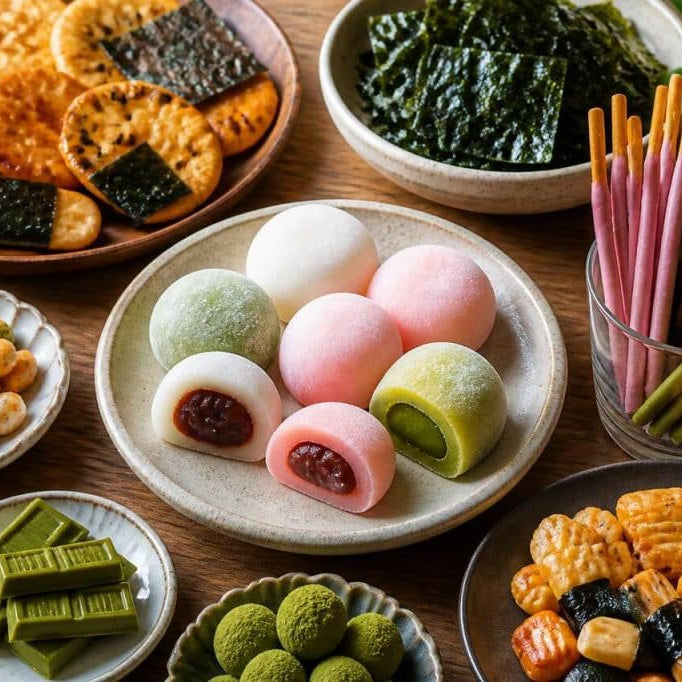
- 1 daifuku or preserved mochi
- 2 Hi-Chew
- 1 limited edition KitKat (the "loot")
The packaging
The wrapping counts almost as much as the content. Three ideas:
Option 1: Square box + tissue paper
A white or pink square box. Line with tissue paper. Arrange the products without stacking them.
Option 2: Furoshiki
A square Japanese scarf (40x40 cm) to wrap the box. Reusable, ecological, super photogenic.
Option 3: Kraft bag + ribbon
Simpler. Kraft bag, raffia ribbon, handwritten label "やッたー" ("Yatta!" = "Hooray!").
Add a personal touch
- A tasting card: list of products + translation + suggested order.
- A QR code to a Spotify City Pop playlist.
- Kawaii stickers.
- Some Japanese chopsticks.
- A small lucky cat (maneki-neko).
Budget tips
- Buy star products in multipacks: more cost-effective per unit.
- Distribute products across 2-3 boxes for multiple people.
- Allow 10-15% extra for packaging costs.
For what occasion?
- Birthday (the "anime fan" box is a hit).
- Valentine's Day (the "tea & cocooning" box).
- Mother's/Father's Day (the "beginner" box).
- Easter (mini-box with Japanese chocolates).
- Moving.
- Christmas gift.
Our final advice
A good Japanese box tells a story. Limit the content to 5-8 products to avoid overcrowding, and choose each product for its angle (discovery, season, curiosity). This is what distinguishes a generic box from a memorable one.
On Japanity, our pre-composed boxes save you the work, but our catalog also allows you to create your own.